- KPRA (Khyber Pakhtunkhwa Revenue Authority)Khyber Pakhtunkhwa
- Updated
KPRARestaurant POS in Peshawar
Restaurant POS software in Peshawar
For the karahi and tikka house that weighs the meat in front of the customer, cooks it on one stove and serves it on charpoys, and for the qehwa house next door.
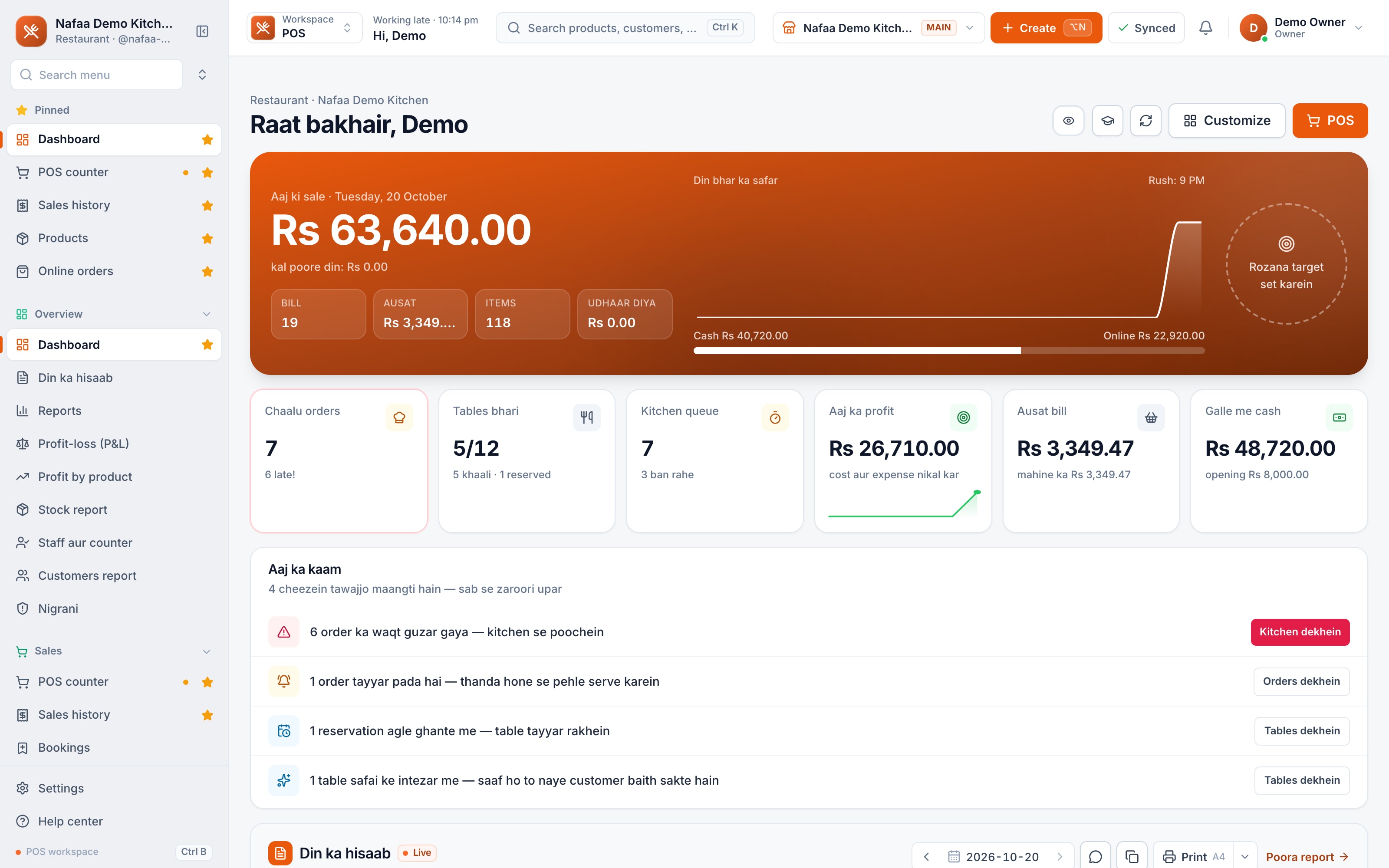
- Half kilo and kilo sizes
- Tickets per station
- Meat cost per plate
Short answer
Nafaa is restaurant POS for Peshawar: karahi and tikka in half-kilo and kilo sizes, tickets for the grill and the karahi stove, family sections and takeaway on one screen, plate cost at today's meat and ghee rates, and a counter that keeps billing through power cuts. It suits a Namak Mandi grill or a chai and qehwa house.
Roman Urdu mein
Peshawar ke restaurant ke liye: karahi aur tikka kilo ke hisaab se, grill aur karahi ki KOT alag, family hall aur parcel ek screen par, aur gosht ya ghee mehnga ho to har plate ki Cost foran nazar aaye.
Key facts
- Built for
- Karahi and BBQ houses, chapli kebab counters, tea and qehwa houses, family restaurants
- Kitchen
- Grill, karahi and tandoor tickets on a printer or kitchen screen
- Costing
- Recipe cost at today's meat, ghee and flour rates
- Price
- Paid plans from Rs 1,500 a month, with a free trial first
Eating out in Peshawar
Peshawar's food is built around meat cooked simply and in front of the customer. In the old city, the Namak Mandi food street sits behind the historic Qissa Khwani Bazaar. On the third day of Eid in 2023, Dawn reported crowds sitting on charpoys there for chapli kebab, barbecue, mutton karahi, pulao and paye, with kehwa to finish. Qissa Khwani itself, once called "the Piccadilly of Central Asia", is known for its chai and qehwa houses.
The way people order here shapes the counter. Karahi and tikka are commonly ordered by weight: a half kilo or a kilo of mutton, chosen and weighed, then cooked on a single stove for that table. The price depends on the weight, the kind of meat and the day's rate. A bill written by hand has to get all three right while the cook is already working.
The menu is short, but the cost is concentrated. Mutton, beef, chicken, ghee and flour make up most of what a Peshawar grill spends, and their prices move often. A place that sets its per-kilo price once a year can find its best-selling dish earning far less than it thinks.
Many places run two kinds of trade at once: a busy takeaway counter for kebabs and naan, and a seated area or family hall where a table stays for an hour. Restaurant services in Khyber Pakhtunkhwa come under the KPRA (sales tax on services explains the provincial side); integration in Nafaa is optional and only needed if your restaurant is registered for it.
Inside the app
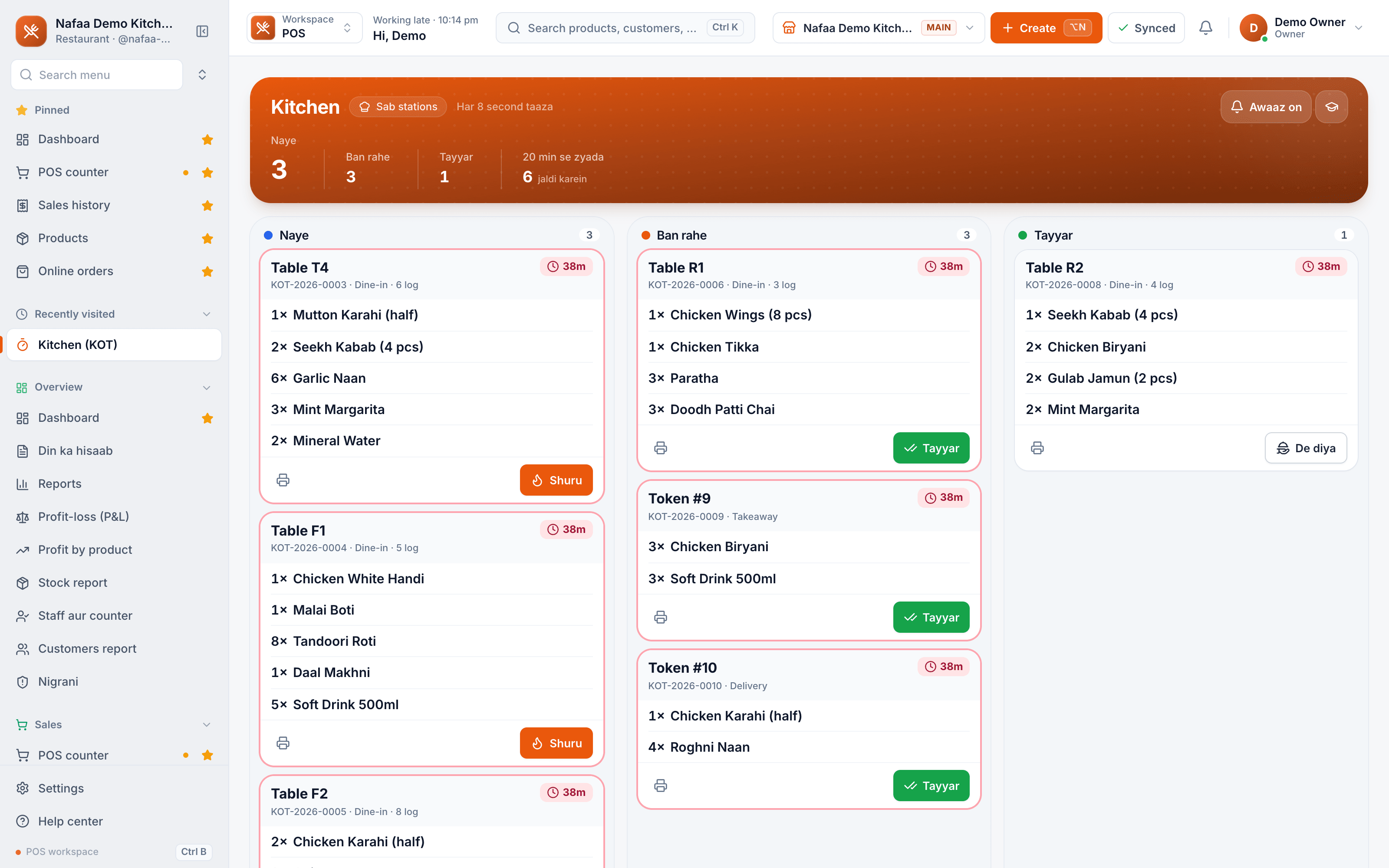
The karahi stove sees its own tickets
Each menu category goes to its station. The karahi cook sees only karahi orders, with the size and the minutes since the ticket came in; the grill gets the tikka and kebabs. A ticket over 20 minutes turns red.
A night at a Peshawar karahi house
Before the rush. Update the day's meat rates. Each dish's recipe is costed from them, so mutton karahi per kilo shows its plate cost and food cost percent before you open.
Taking the order. A table orders one kilo of mutton karahi, half a kilo of tikka, naan and salad. The karahi goes on the bill in its size, kilo or half kilo, at that size's rate, and add-ons such as extra green chillies or less salt are printed on the ticket for the cook.
Takeaway. Chapli kebab and naan for collection are taken in quick counter mode: the order gets a token, goes to the kitchen and is paid at once, so the takeaway queue does not wait behind the tables.
Paying. Families often split the bill or pay part in cash and part by wallet. Split the bill, merge tables that joined, and record cash, card, JazzCash or Easypaisa on one receipt.
Closing late. Set your business day to start in the early morning, so sales after midnight count toward the night they belong to. Close the cash register against the cash in the drawer.
Peshawar restaurant jobs and the screen that takes them
| Feature | On paper | In Nafaa |
|---|---|---|
| Karahi ordered by the kilo | Weight and rate written by hand | Half kilo and kilo as sizes with their own rates |
| One stove per table's order | Shouted across the kitchen | Ticket printed at the karahi station |
| Meat price goes up | Price list changed months later | Plate cost updates from the new rate |
| Takeaway queue | Waits behind the tables | Quick counter with token and payment |
| Family pays in parts | Long sums at the counter | Split bill, cash and wallet on one receipt |
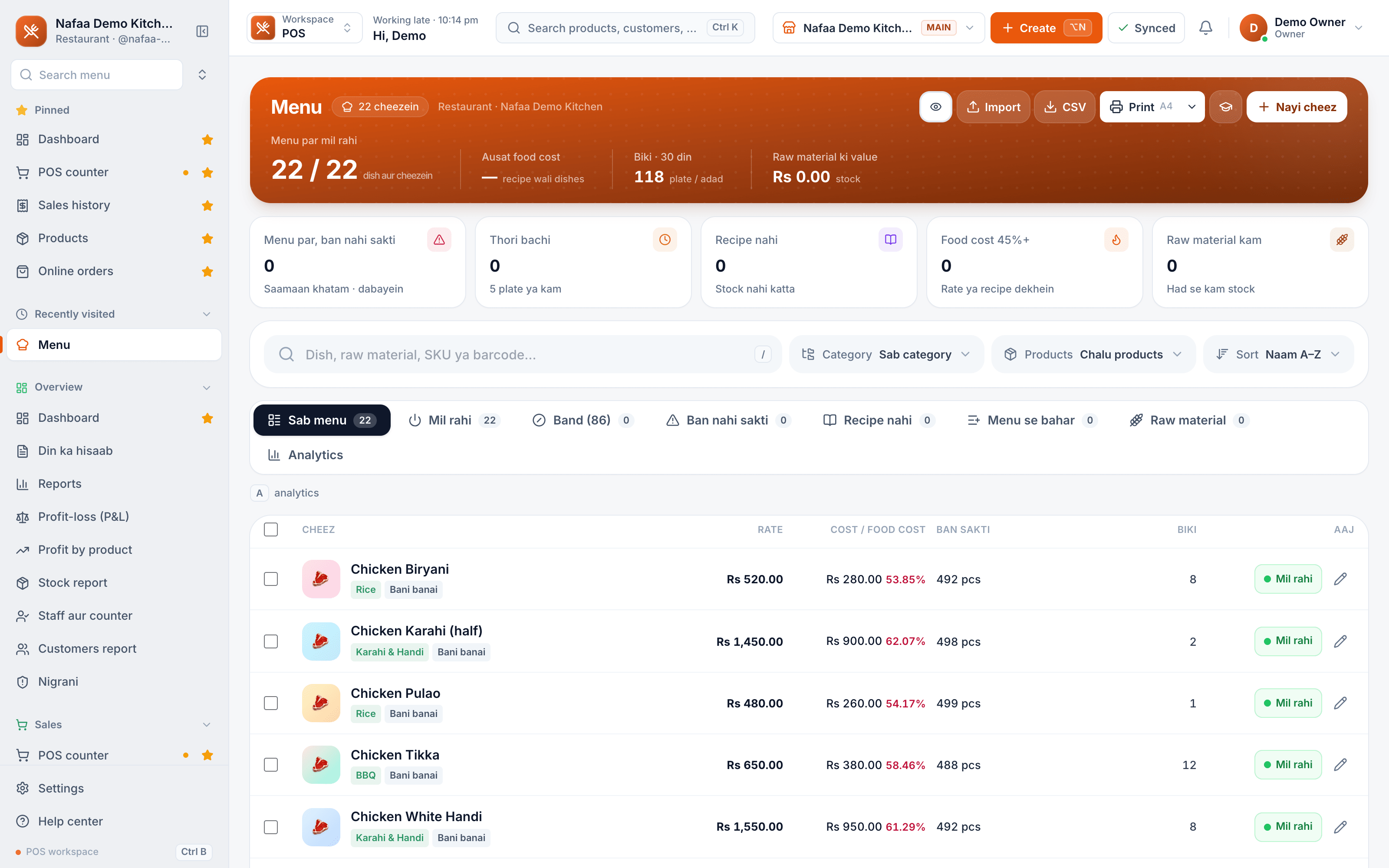
Know what each plate costs today
The menu lists plate cost, food cost percent and how many plates the stock still covers. Dishes whose cost has crept up are marked, so you can change the per-kilo rate before the weekend.
Getting started
Opening on Nafaa in Peshawar
- 1
Send your menu
A photo of the rate board or a list on WhatsApp is enough to start.
- 2
Set up dish sizes
Karahi and tikka in half kilo and kilo sizes, each with its rate.
- 3
Name your stations
Karahi, grill, tandoor and tea, each with a printer or a kitchen screen.
- 4
Train the counter
A short call for the cashier and waiters, in plain Urdu.
Questions from Peshawar restaurant owners
Can the price change with the quantity the customer picks?
Yes. Give a dish sizes such as quarter, half kilo and kilo, each with its own rate, and the bill follows the size ordered. When meat rates change, update the size prices once.
We serve tea and qehwa all day. Can I give a cheaper afternoon rate?
Yes. Happy hours cut prices by time, day, dish or order type, and the counter applies them by itself.
Power goes several times a day. Will billing stop?
No. Orders and bills keep working on the device without internet and sync when it returns. Keep the device charged or on a UPS.
Do you have a guide to kitchen tickets?
See the guide to a KOT system for restaurants, the restaurant page and Peshawar for the other trades the same account covers.
Plans for Peshawar
Free
Choti dukaan ke liye hamesha muft: 1 dukaan, 1 user, 300 bill mahana.
Rs 0
What is included
- 100 products
- 300 sales a month
- 1 user
- 1 shop
Basic
Chhoti dukan ke liye perfect
Rs 1,500/ monthRs 4,000/ quarterSave 11%Rs 15,000/ yearSave 16%Get startedStarts with a 7-day free trial
What is included
- 5,000 products
- Unlimited sales
- 3 users
- 1 shop
Pro
RecommendedBari shops aur multi-branch ke liye
Rs 3,500/ monthRs 9,500/ quarterSave 9%Rs 36,000/ yearSave 14%Get startedStarts with a 7-day free trial
What is included
- Unlimited products
- Unlimited sales
- 10 users
- 3 shops
Enterprise
Unlimited everything + 24/7 support
Rs 9,500/ monthRs 27,000/ quarterSave 5%Rs 99,000/ yearSave 13%Get startedStarts with a 7-day free trial
What is included
- Unlimited products
- Unlimited sales
- Unlimited users
- Unlimited shops
More about Peshawar
- All cities
Peshawar
Nafaa is POS, stock and khata software for Peshawar restaurants, meat shops, jewellers, dry fruit and carpet dealers, and electronics traders. It runs on the phone or computer at the counter, keeps billing when the power or network fails, and keeps trade credit in a digital khata.
- Restaurant software across Pakistan
Restaurant & Cafe
Nafaa runs dine-in, takeaway and delivery for restaurants and cafes: a table layout, kitchen order tickets (KOT) sent to each station's printer or screen, add-ons on dishes, recipes, riders for delivery, happy-hour prices, and bills paid by cash, card, wallet, split or khata.
More questions
Can each kitchen station get its own tickets?
Yes. You set up stations such as grill, tandoor, karahi, Chinese or bar and give each one whole menu categories. Every dish then prints its KOT at its own station, on a printer or a kitchen screen. Categories not given to a station go to the first station, so no order is lost.
Can a table pay in more than one way?
Yes. A bill can be paid by cash, card or wallet, split across more than one method, paid in part now and the rest later, or put fully on the customer's khata. Whatever is left unpaid shows as udhaar against that customer, so nothing is lost between shifts.
Does Nafaa work without internet?
Yes, the counter keeps billing when the internet drops. Sales made offline are saved on the device and sent to your account automatically when the connection comes back, and you can see the sales still waiting to be sent. Reports and other branches see those sales once they have synced.
How much does Nafaa cost?
Paid plans start at Rs 1,500 a month. The pricing page lists every plan with its price and limits, taken straight from our plan settings, so it is always current. You can start with the free trial first, and no credit card is needed to sign up.
Bring your Peshawar kitchen onto one screen
Start free with your own menu and rates. Setup help on WhatsApp.
- 7 din Free Trial
- Keeps billing offline
- Help on WhatsApp