- SRB (Sindh Revenue Board)Sindh
- Updated
SRBRestaurant POS in Karachi
Restaurant POS software in Karachi
From a nihari counter on Burnes Road to a family hall on a food street in Bahadurabad: orders, kitchen tickets, riders and the night's cash in one app.
- Kitchen tickets per station
- Riders and cash
- Late-night shifts
Short answer
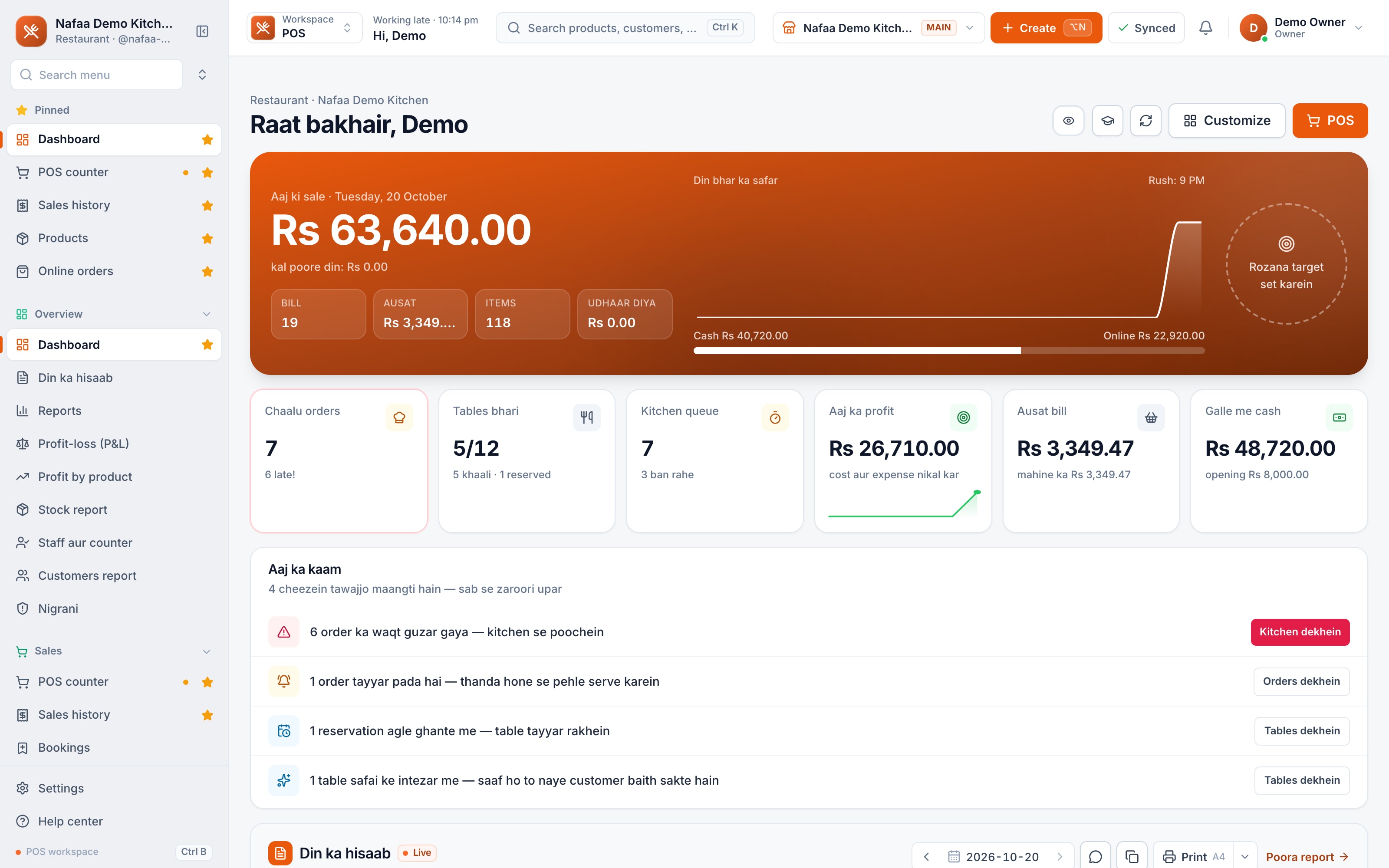
Nafaa is restaurant POS for Karachi: tables and takeaway on one screen, kitchen tickets for the grill, tandoor and karahi, riders with the cash they still hold, and plate costs at today's prices. It suits a Burnes Road counter or a sit-down place in Clifton, and keeps taking orders without internet.
Roman Urdu mein
Karachi ke restaurant ke liye: table, parcel aur delivery ek screen par, har station ki KOT alag, rider ke paas kitna cash hai woh bhi saamne. Raat der tak shift chale to bhi hisaab saaf.
Key facts
- Built for
- Dine-in halls, takeaway counters, BBQ and karahi places, cafés and cloud kitchens
- Kitchen
- Tickets per station on a printer or kitchen screen
- Delivery
- Riders, order stages and the cash each rider still holds
- Price
- Paid plans from Rs 1,500 a month, with a free trial first
Eating out in Karachi
Karachi eats late and eats on the street. Burnes Road, officially Muhammad Bin Qasim Road, is known across the city for restaurants and food vendors, many of them founded in the 1940s. The city's published list of food streets runs from Hussainabad, Sharafabad, Bahadurabad and Dhoraji to Boat Basin and the DHA food streets, alongside planned spots like Port Grand.
These places are rarely quiet in the same way. A Burnes Road counter may serve hundreds of plates of one dish to walk-in customers, while a family restaurant in Clifton seats tables for an hour and sends parcels to apartments across the area. Many do both, plus delivery through riders and food apps.
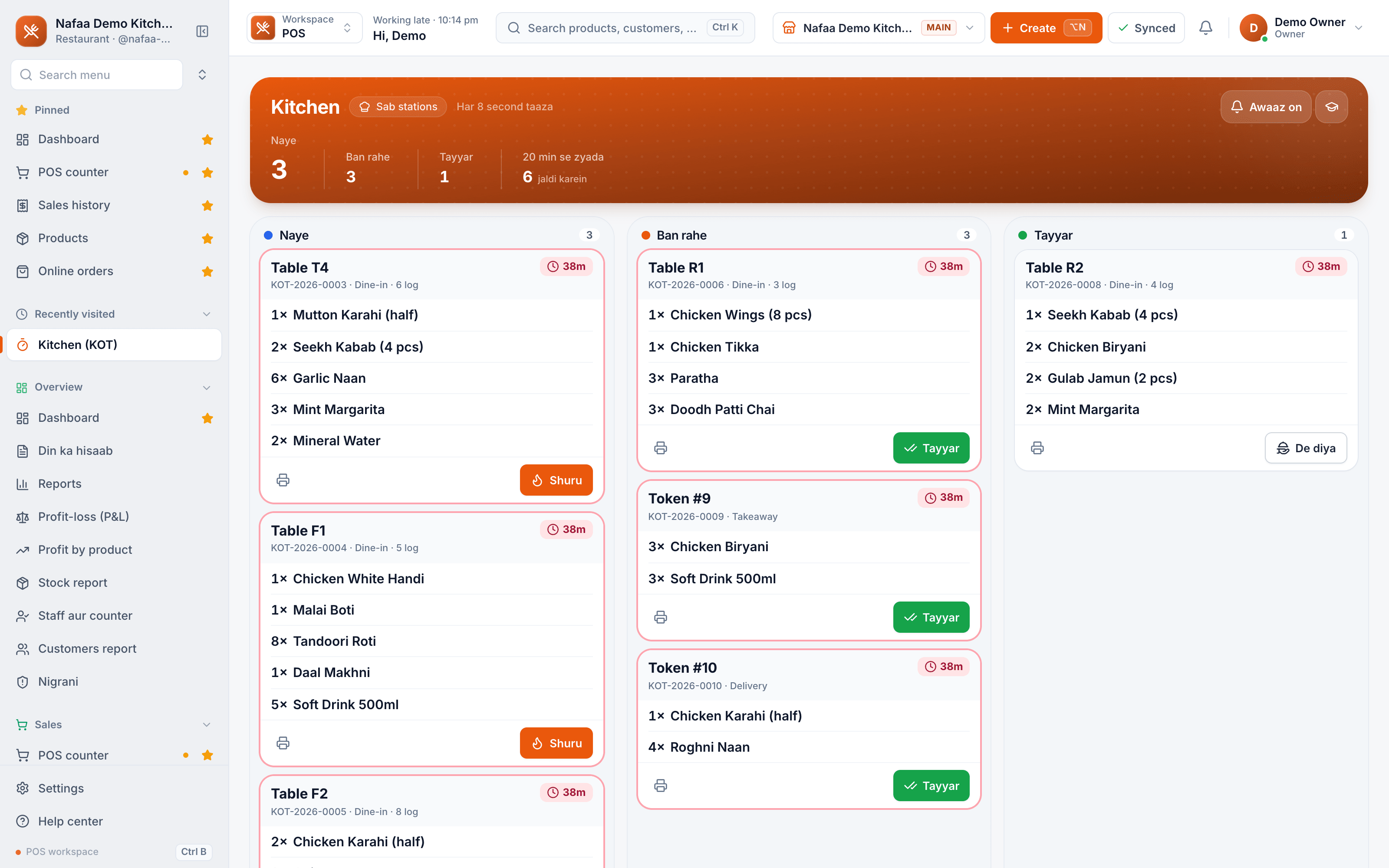
The kitchen is split by station. Grills, tandoors and karahi stoves each have their own cook, and a single order often touches all three. When a ticket is written once and shouted across the kitchen, items get missed and plates leave in the wrong order.
Payment habits differ by place. A food-street counter is mostly cash, a café in DHA takes cards and wallets, and delivery customers often pay the rider in cash at the door, which then sits with the rider until the shift ends.
Restaurant services in Sindh are taxed by the Sindh Revenue Board (see sales tax on services); integration in Nafaa is optional and only needed if your restaurant is registered for it.
Inside the app
One kitchen screen for the grill, tandoor and karahi
Each menu category goes to its own station. Cooks see new, cooking and ready tickets with the minutes since they came in, so a karahi waiting twenty minutes stands out before the customer complains.
A night at a Karachi restaurant
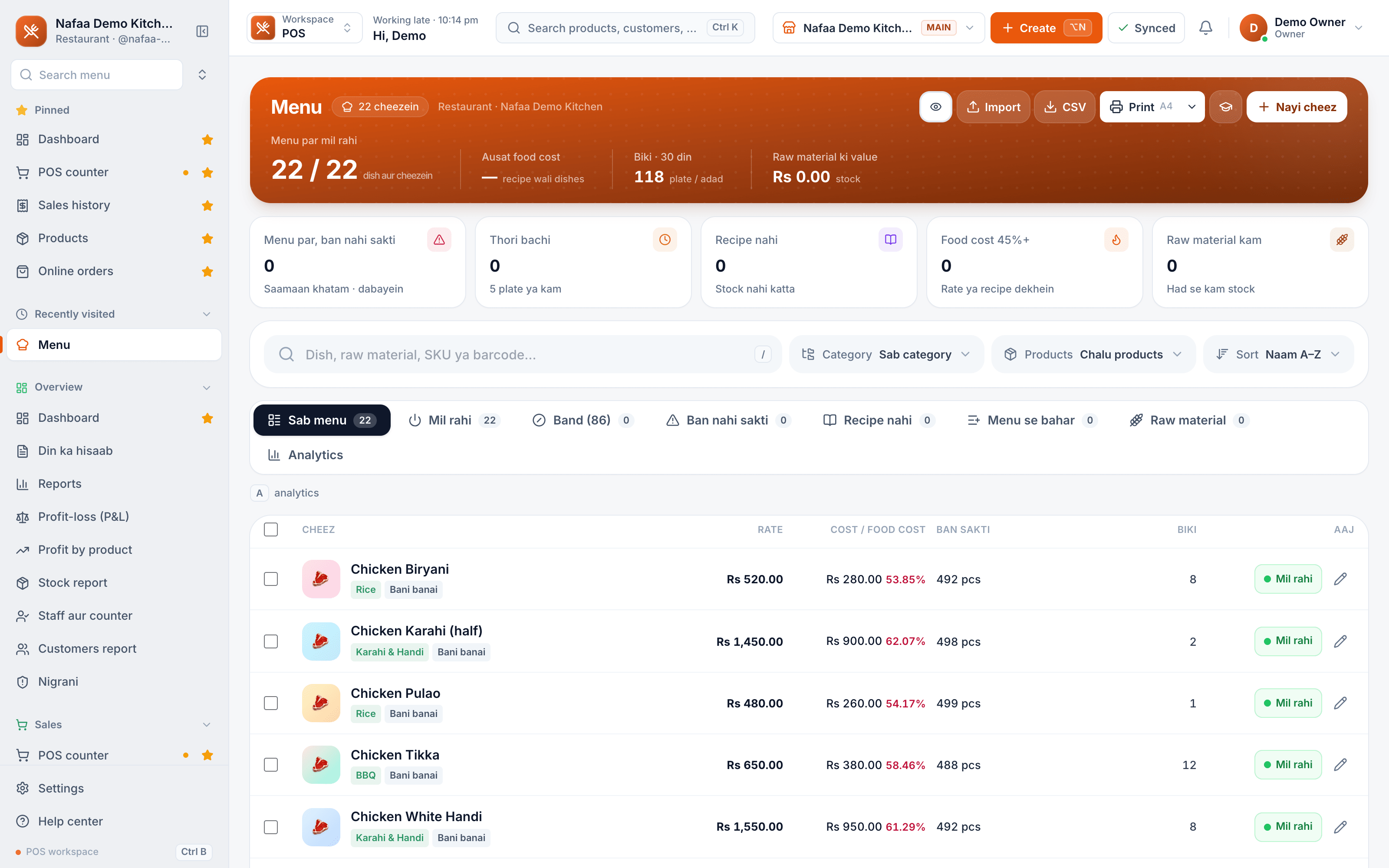
Before opening. Check the menu prices and today's specials. Recipes are costed at today's ingredient rates, so when chicken or ghee prices change the food-cost percent moves with them.
Rush hour. Waiters take orders at the table on a phone, and the tickets print at the right station. Takeaway customers get a token, pay at the counter and wait for their number. Add-ons such as extra raita or less spice are priced on the bill and printed on the ticket.
Delivery. Orders move from waiting for a rider to out for delivery to delivered. Each rider's cash in hand is listed, so at the end of the shift you know who has to hand over how much.
After midnight. Many Karachi places close well after midnight. Set the business day to start at, say, 4 a.m., and sales made at 1:30 a.m. count toward the night they belong to. Close the cash register against the cash actually in the drawer.
Karachi restaurant jobs and how Nafaa handles them
| Feature | Without a system | In Nafaa |
|---|---|---|
| One order for three stations | One slip, shouted across | Separate tickets per station |
| Takeaway rush | Names written on bags | Token number on the bill and the ticket |
| Riders' cash | Counted at closing from memory | Cash in hand per rider, live |
| Food cost when prices change | Noticed weeks later in the profit | Plate cost at today's rates |
| Happy-hour chai | Cashier remembers the discount | Price cut by time and day, applied by itself |
Know which plates earn
The menu shows each dish's plate cost, food cost percent and how many plates the stock still covers, so you can see which items need a new price before a busy weekend.
Getting started
Opening on Nafaa in Karachi
- 1
Send your menu
A photo of the menu card or a spreadsheet on WhatsApp is enough to start.
- 2
Set your stations
Grill, tandoor, karahi, drinks: each gets a printer or a kitchen screen.
- 3
Lay out the floor
Add sections and tables, and the takeaway and delivery counters.
- 4
Train the shift
A short call for cashiers and waiters before the evening rush.
Questions from Karachi restaurant owners
We run until 3 a.m. Which day do late sales go to?
You choose the hour your business day starts. With a 4 a.m. start, everything sold after midnight stays with that night in the dashboard and the sales history.
Can waiters take orders on their own phones?
Yes. The app runs in the browser on any phone, and staff roles decide who can give a discount or cancel an item.
What happens when the internet drops during the rush?
Orders and bills keep working on the device and sync when the connection returns, so the counter does not stop mid-rush.
Can I split a bill between friends?
Yes. Split, merge or move tables, and take part of the payment by cash, card or wallet.
We have one kitchen and two counters, dine-in and parcel. Is that one setup?
Yes. Both counters send tickets to the same stations, and the kitchen screen marks each ticket as dine-in, takeaway or delivery so the cooks know how to pack it. Parcel orders get a token number that is printed on both the bill and the kitchen ticket, which matters on a crowded pavement where names get mixed up. More on station tickets in our KOT guide.
Plans for Karachi
Free
Choti dukaan ke liye hamesha muft: 1 dukaan, 1 user, 300 bill mahana.
Rs 0
What is included
- 100 products
- 300 sales a month
- 1 user
- 1 shop
Basic
Chhoti dukan ke liye perfect
Rs 1,500/ monthRs 4,000/ quarterSave 11%Rs 15,000/ yearSave 16%Get startedStarts with a 7-day free trial
What is included
- 5,000 products
- Unlimited sales
- 3 users
- 1 shop
Pro
RecommendedBari shops aur multi-branch ke liye
Rs 3,500/ monthRs 9,500/ quarterSave 9%Rs 36,000/ yearSave 14%Get startedStarts with a 7-day free trial
What is included
- Unlimited products
- Unlimited sales
- 10 users
- 3 shops
Enterprise
Unlimited everything + 24/7 support
Rs 9,500/ monthRs 27,000/ quarterSave 5%Rs 99,000/ yearSave 13%Get startedStarts with a 7-day free trial
What is included
- Unlimited products
- Unlimited sales
- Unlimited users
- Unlimited shops
More about Karachi
- All cities
Karachi
Nafaa is POS, stock and khata software for Karachi shops, wholesalers and restaurants. It bills on the phone or computer at your counter, keeps working through K-Electric outages and weak signal, and keeps trade credit and customer udhaar in one digital khata.
- Restaurant software across Pakistan
Restaurant & Cafe
Nafaa runs dine-in, takeaway and delivery for restaurants and cafes: a table layout, kitchen order tickets (KOT) sent to each station's printer or screen, add-ons on dishes, recipes, riders for delivery, happy-hour prices, and bills paid by cash, card, wallet, split or khata.
More questions
Can each kitchen station get its own tickets?
Yes. You set up stations such as grill, tandoor, karahi, Chinese or bar and give each one whole menu categories. Every dish then prints its KOT at its own station, on a printer or a kitchen screen. Categories not given to a station go to the first station, so no order is lost.
Can a table pay in more than one way?
Yes. A bill can be paid by cash, card or wallet, split across more than one method, paid in part now and the rest later, or put fully on the customer's khata. Whatever is left unpaid shows as udhaar against that customer, so nothing is lost between shifts.
Does Nafaa work without internet?
Yes, the counter keeps billing when the internet drops. Sales made offline are saved on the device and sent to your account automatically when the connection comes back, and you can see the sales still waiting to be sent. Reports and other branches see those sales once they have synced.
How much does Nafaa cost?
Paid plans start at Rs 1,500 a month. The pricing page lists every plan with its price and limits, taken straight from our plan settings, so it is always current. You can start with the free trial first, and no credit card is needed to sign up.
Bring your Karachi kitchen onto one screen
Start free with your own menu. Setup help on WhatsApp, in Urdu or English.
- 7 din Free Trial
- Keeps billing offline
- Help on WhatsApp