- PRA (Punjab Revenue Authority)Punjab
- Updated
PRAClothing shop POS in Rawalpindi
Clothing shop POS in Rawalpindi
From the women's bazaar of the old city to the boutiques of Saddar: ready stock, unstitched suits and stitching orders in one app.
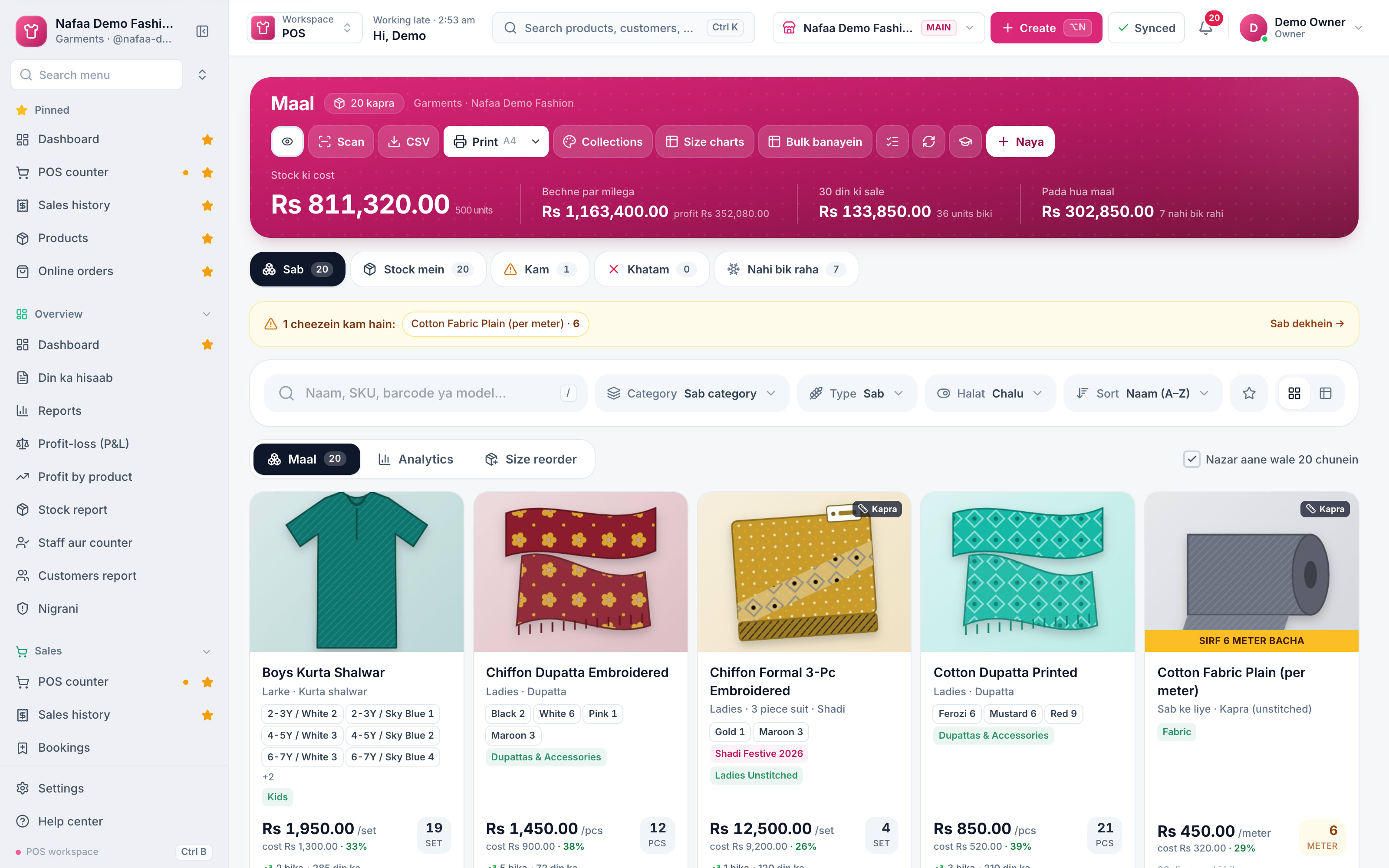
- Size and colour barcodes
- Ladies' silai orders
- Hold on deposit
Short answer
Nafaa is POS for Rawalpindi clothing, fabric and boutique shops: every size and colour with its own barcode, ladies' stitching orders with saved measurements, exchanges on the original bill, and wedding outfits held on a deposit. It fits a Moti Bazaar shop, a Bank Road boutique or a Kashmir Road tailor.
Roman Urdu mein
Pindi ki kapre ki dukaan aur boutique ke liye: har size aur rang ka alag barcode, ladies silai ka order naap ke saath, purane bill par exchange aur shaadi ke jore par advance rakh kar hold.
Key facts
- Built for
- Ready-made, unstitched fabric, bridal and boutique shops, and ladies' tailors
- Stock
- Each size and colour as its own variant and barcode
- Orders
- Silai and alterations with measurements, trial date and advance
- Price
- Paid plans from Rs 1,500 a month, with a free trial first
Rawalpindi's clothing streets
Clothes in Rawalpindi are sold in two very different settings. In the old city, Moti Bazaar was founded in 1911 with about twenty shops; it now has more than 1,200, and for most of its history it was a bazaar for women only. It sits beside Raja Bazaar, which has its own Kapra Bazaar for cloth among the smaller markets inside it. Here the trade is unstitched suits, lace, dupattas and everything a family needs before a wedding, sold over the counter in a crowd.
In the cantonment, Saddar is the principal commercial hub. Bank Road has markets for branded garments, boutiques and shops for ceremonial dresses, and Kashmir Road is known for branded clothing shops and for tailors who stitch ladies' clothes. A customer may buy fabric in Moti Bazaar in the morning and hand it to a Kashmir Road tailor the same afternoon.
So a Rawalpindi shop often does three jobs at once. It sells ready pieces in many sizes, it sells unstitched fabric, and it takes stitching orders that come back days later for a trial. Wedding season adds holds: an outfit set aside with a deposit, paid off over weeks.
Each of those jobs has a paper slip, and slips are what go missing when the shop is busy before Eid or in the wedding months.
Inside the app
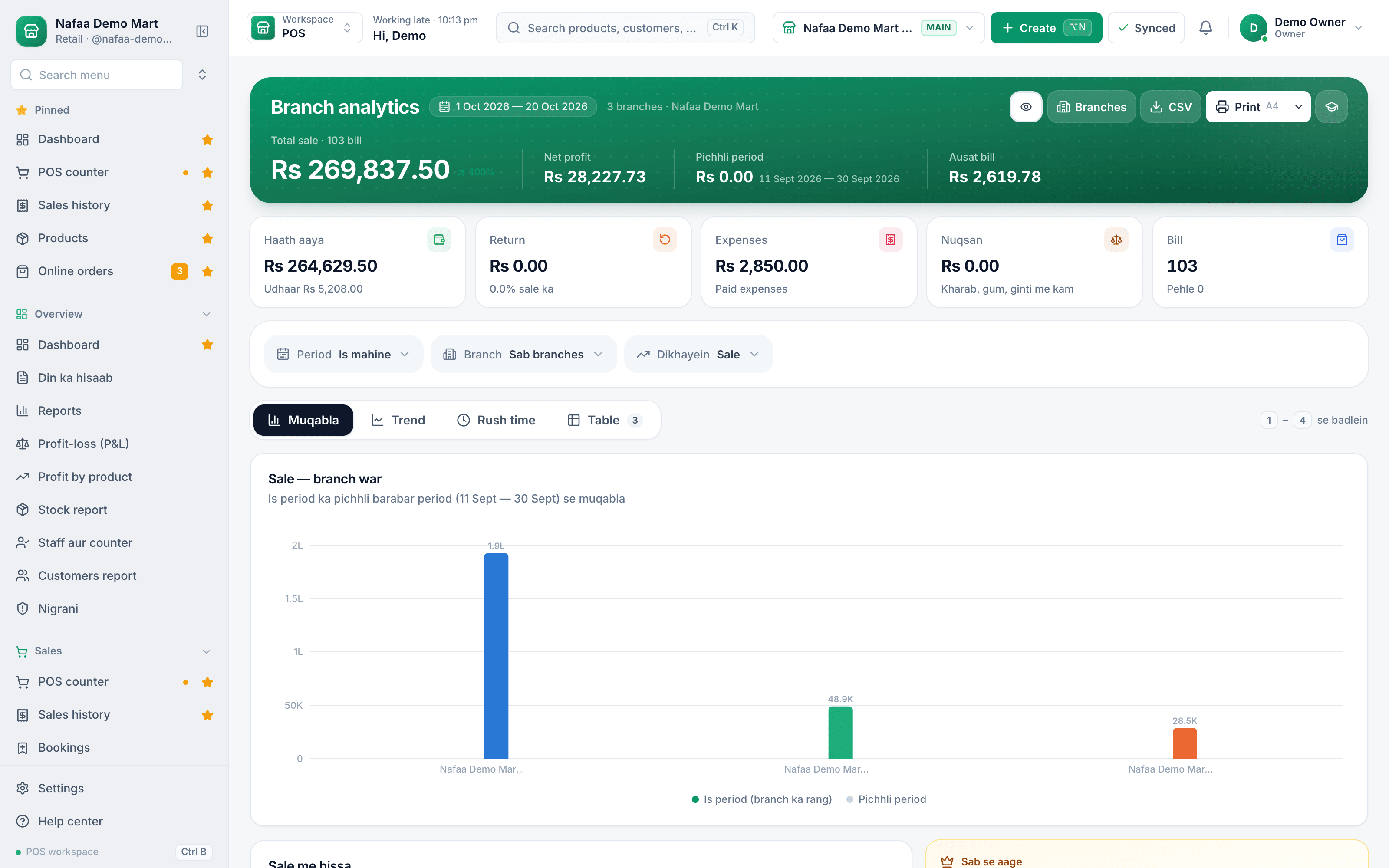
Two branches, one view of stock
A shop in the old city and a boutique in Saddar show side by side: sale, profit, average bill, expenses and returns per branch. When one branch runs out of a size, move it from the other.
How the work runs in a Rawalpindi shop
New lot. Build an article once with its size and colour grid. Every variant gets a barcode, and an empty size shows in red so you see the gap before a customer does. Group stock into collections such as Eid or Winter, and put a percent Sale on a whole collection when the season turns.
Stitching. A customer brings fabric for a suit. Her measurements are saved under her name, several sets if she orders for her daughters too, and reused on the next order. The silai order carries the design pictures, the karigar, the trial date and the advance. Size charts for each garment type are ready to show at the counter.
Alterations. A dress bought elsewhere comes in for fitting. It gets a token and a due date, and the customer hears on WhatsApp when it is ready.
Weddings. A bridal outfit can be held with a deposit or sold on a qist plan paid over weeks or months, and it stays off the shelf until it is paid or the hold ends.
After Eid. Exchanges come back on the original bill; the returned piece pays toward the new one and only the difference changes hands.
Rawalpindi shops and the screens they start with
| Feature | Set up first | Add later |
|---|---|---|
| Unstitched suit and lace shop | Articles by design and colour, barcodes | Eid and wedding collections with Sale |
| Bank Road boutique | Size grid, exchanges | Branch transfers, profit by collection |
| Ceremonial and bridal wear | Hold on deposit, qist plans | WhatsApp reminders on balances |
| Ladies' tailor | Silai orders with saved measurements | Alterations with token and due date |
| Shop with its own karigar | Orders by karigar and trial date | Size charts per garment type |
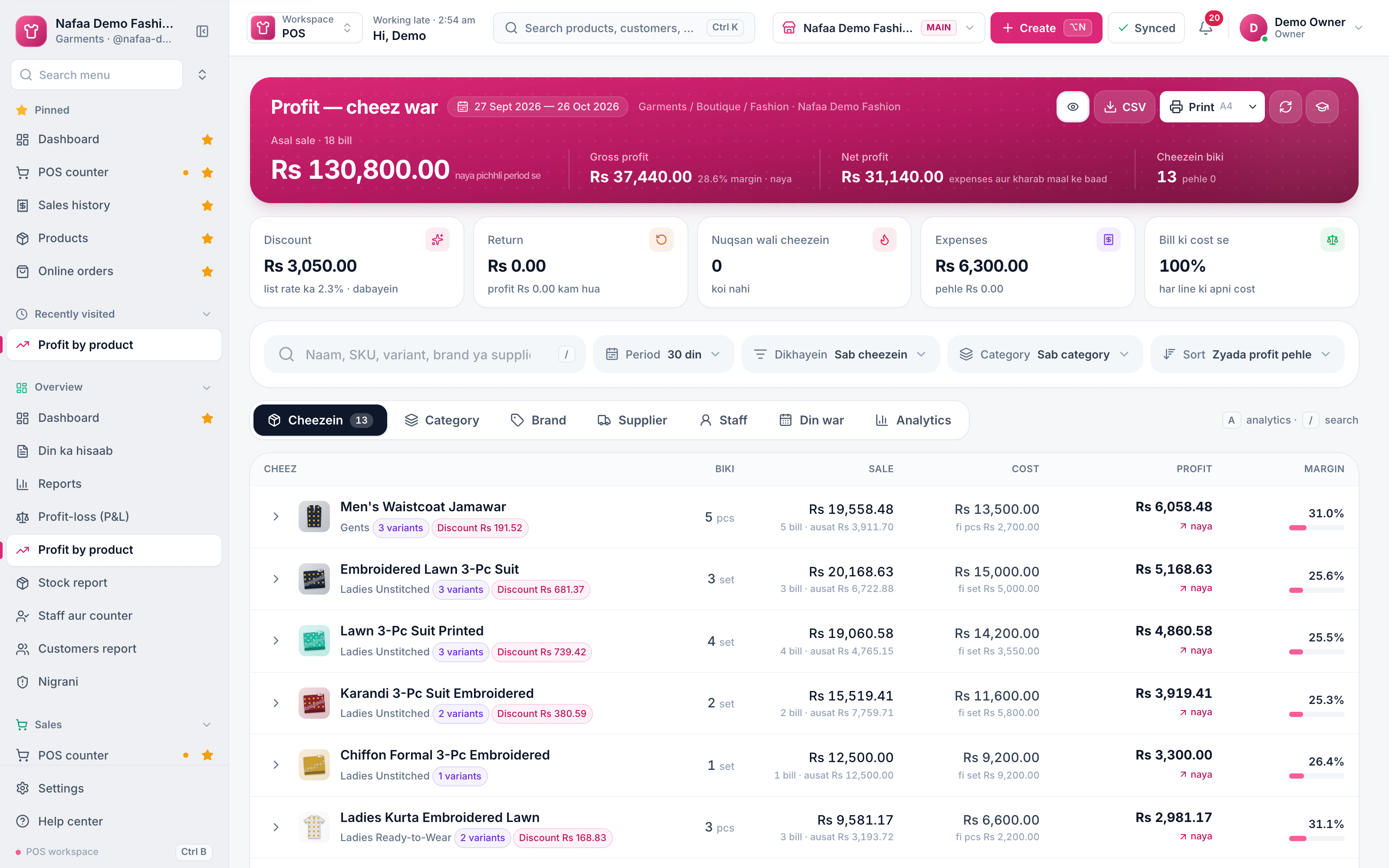
See which articles really earned
Profit by product, category, brand or supplier shows which designs carried the season. The next order from the wholesaler follows what sold, not what looked good on the hanger.
Getting started
Setting up a Rawalpindi clothing shop
- 1
Start the trial
Sign up on the phone or computer at the counter; no card needed.
- 2
Add your articles
Use the size and colour grid and print barcode labels.
- 3
Enter open silai orders
Each pending order with its measurements, trial date and advance.
- 4
Set your exchange days
Choose how many days you allow and who can approve a late exchange.
Questions from Rawalpindi clothing shops
I sell unstitched suits and also stitch them. Is that one product or two?
The suit is one product. The stitching is a silai order linked to the customer, with its own charge and advance, so the fabric sale and the stitching both show correctly.
A customer wants to keep a bridal dress for three weeks. How do I record it?
Hold it with her deposit. It stays out of the stock you can sell, and the balance sits on her account until she collects it.
Can my salesmen give discounts during the wedding rush?
Only if their role allows it. Discounts, exchanges and refunds can be limited to the owner or a manager.
A regular customer lost her measurement slip. Do I need to measure again?
No. Her measurements are saved under her name, with separate sets for anyone she orders for, so the next suit starts from the last naap. Change only what she asks to change, and the new set is kept for next time.
What about the Eid rush, when three people are billing at once?
Each salesman can bill from his own phone at the same time. Stock is shared, so a size sold on one phone disappears from the others, and the owner sees every bill as it is made.
Where can I compare this with other cities?
The Faisalabad clothing page covers a cloth-market city, and Rawalpindi lists the other trades here.
Plans for Rawalpindi
Free
Choti dukaan ke liye hamesha muft: 1 dukaan, 1 user, 300 bill mahana.
Rs 0
What is included
- 100 products
- 300 sales a month
- 1 user
- 1 shop
Basic
Chhoti dukan ke liye perfect
Rs 1,500/ monthRs 4,000/ quarterSave 11%Rs 15,000/ yearSave 16%Get startedStarts with a 7-day free trial
What is included
- 5,000 products
- Unlimited sales
- 3 users
- 1 shop
Pro
RecommendedBari shops aur multi-branch ke liye
Rs 3,500/ monthRs 9,500/ quarterSave 9%Rs 36,000/ yearSave 14%Get startedStarts with a 7-day free trial
What is included
- Unlimited products
- Unlimited sales
- 10 users
- 3 shops
Enterprise
Unlimited everything + 24/7 support
Rs 9,500/ monthRs 27,000/ quarterSave 5%Rs 99,000/ yearSave 13%Get startedStarts with a 7-day free trial
What is included
- Unlimited products
- Unlimited sales
- Unlimited users
- Unlimited shops
More about Rawalpindi
- All cities
Rawalpindi
Nafaa is POS, stock and khata software for Rawalpindi wholesalers, cloth and jewellery shops, grocers and restaurants. It runs on the phone or computer at the counter, keeps billing in crowded bazaars with weak signal, and keeps trade and household udhaar in a digital khata.
- Garments software across Pakistan
Garments & Boutique
Nafaa runs garment shops and boutiques that sell ready-made and custom-stitched clothes: stock by size and colour, tailoring (silai) orders, alterations, saved customer measurements, items put on hold, qist plans, exchanges, collections and size charts, alongside the counter, khata and reports.
More questions
How are sizes and colours handled?
Each size and colour of a product is its own stock line, so you see exactly which sizes and colours are in stock and which are selling. Size charts and collections help you group stock, and exchanges at the counter put the returned size back into stock.
Can I save customer measurements?
Yes. Each customer can have one or more measurement records, for example their own kameez and a child's frock, with the unit, the numbers grouped the way a tailor takes them, and fitting notes. A new stitching order opens those measurements, so a regular customer is not measured every time.
Can a customer reserve an expensive item and pay over time?
Yes. You can put an item on hold for a customer, or sell it on a qist plan where the customer pays in parts and takes it when it is paid. Both keep the item out of normal stock, so it is not sold to someone else.
How much does Nafaa cost?
Paid plans start at Rs 1,500 a month. The pricing page lists every plan with its price and limits, taken straight from our plan settings, so it is always current. You can start with the free trial first, and no credit card is needed to sign up.
Get your Rawalpindi shop ready for wedding season
Free trial on the device you already have, with setup help on WhatsApp in Urdu or English.
- 7 din Free Trial
- Keeps billing offline
- Help on WhatsApp