- Fact-checked
- Updated
Compare
Nafaa vs DigiKhata for a Pakistani shop
DigiKhata is a free bookkeeping and khata app with ledgers, cash book, stock book, staff book, card acceptance on the phone and small business loans. Nafaa is a POS-first system where udhaar, stock and staff hang off the bill at the counter. This page compares them fairly and says when DigiKhata is the better choice.
Which one should you choose?
DigiKhata is a free bookkeeping and khata app with ledgers, cash book, stock book, staff book, card acceptance on the phone and small business loans. Nafaa is a POS-first system where udhaar, stock and staff hang off the bill at the counter. This page compares them fairly and says when DigiKhata is the better choice.
Roman Urdu mein
Agar zyada kaam udhaar aur cash ka hisaab likhna hai to DigiKhata kaafi hai. Agar counter par roz bohat bill bante hain aur Stock, udhaar aur galla ek saath chalna chahiye, to Nafaa behtar hai.
Key facts
- Short answer
- DigiKhata for a free phone ledger; Nafaa when the counter, stock and udhaar must stay in step on every bill.
- Choose DigiKhata if
- You record entries by hand, sell little from a counter, and want card tap and QR on the same phone.
- Choose Nafaa if
- You bill many customers a day, sell from stock with barcodes, and want udhaar to come from the bill itself.
- Both keep
- Customer and supplier balances, reminders, staff records and stock levels
- Nafaa price
- Free plan for very small shops; paid plans from Rs 1,500 a month, after a 7-day free trial
At a glance
Nafaa
- Price
- Paid plans from Rs 1,500 a month See pricing
- Free trial
- Free
DigiKhata
- Website
- digikhata.pk
Written by the Nafaa team. Competitor details come from their own pages and are dated; tell us if something has changed and we will update it. Last checked: .
Two different starting points
DigiKhata describes itself as a "super app for small businesses". Its website lists a set of "books": a Party Ledger for customers, suppliers and bank balances, a Staff Book for attendance and payroll, a Stock Book, a Cash Book, a Bill Book for invoices and an Expense Book. Around those it offers reminders with customizable templates (its app listings say SMS and WhatsApp), access rights for staff, a PIN or fingerprint lock, and several businesses under one account. It also goes beyond record keeping: the phone can take card payments by NFC tap after KYC, a DigiQR code takes payments with a 0% transaction fee, and eligible businesses can apply for loans of up to 50,000 rupees. It runs on Android, iOS and online, the website offers a Windows app download, and the App Store description says the app can be used in English, Urdu, Persian and Pashto. In both app stores it is now listed as "Digi Business Accounting".
Nafaa starts from the bill. The cashier scans or searches items at the counter, the customer pays by cash, card, JazzCash, Easypaisa, bank transfer or udhaar, and that one action reduces stock, posts the udhaar to the customer's khata and records the money in the right drawer or account. Stock, purchasing, suppliers, staff, expenses and reports are built around those bills.
So the honest question is not which app is "better", but where your day begins: with a notebook of entries, or with a queue at the counter.
Nafaa and DigiKhata side by side
| Feature | Nafaa | DigiKhata |
|---|---|---|
| What it is built for | Running a counter: billing, stock, khata, staff and reports in one account | Bookkeeping "books": party ledger, cash, stock, staff, bills and expenses |
| How udhaar gets recorded | Chosen as a payment method on the bill, so it lands in the khata with the items | Entered in the party ledger; invoices from the Bill Book |
| Counter billing | Barcode, search and quick keys, receipt printer, cash drawer, customer display | Bill Book invoices; Play listing mentions adding stock items with a barcode scanner |
| Stock | Every sale, purchase and return moves stock, per branch, with variants, units and batches | Stock Book with stock levels and low-stock warnings |
| Reminders | WhatsApp reminders from the khata, sorted by how old the balance is | SMS and WhatsApp reminders with templates; Play listing says unlimited and free |
| Taking payments | Records cash, card, wallets and bank; shows your own Raast, JazzCash or Easypaisa QR with the bill amount | Card tap on the phone after KYC; DigiQR with 0% transaction fee |
| Without internet | Counter keeps billing; sales sync when the connection returns | Play listing: manage ledgers without internet, back up when online |
| Devices | Android and iPhone app, browser on any device, Windows app for the main counter | Android, iOS, web and a Windows app |
| Languages | English, Urdu and Roman Urdu | English, Urdu, Persian and Pashto (App Store description) |
| Price | A Free plan for very small shops; paid plans from Rs 1,500 a month after a 7-day free trial | Free to download; the Pakistan App Store lists in-app purchases: Monthly 790 rupees, Quarterly 1,850 rupees, Annual 5,500 rupees |
Sources
- DigiKhata home page (features, apps, payments, company) · DigiKhata · Accessed
- DigiKhata on Google Play (features, offline access, in-app purchases) · Google Play · Accessed
- DigiKhata on the App Store, Pakistan (description languages, in-app purchase prices) · Apple App Store · Accessed
Checked on
When DigiKhata is the better choice
- You want to start free. DigiKhata is free to download, and its listings describe free reminders and PDF reports. Its App Store listing also shows paid in-app purchases, so check what the free version covers. Nafaa has a Free plan with small limits for one shop and one user; beyond that it is a paid product after the trial.
- Your sales are few and large. A wholesaler or contractor who writes ten invoices a day does not need a fast counter. A clean ledger with reminders may be all you need.
- You want to take cards without a machine. DigiKhata's card tap on the phone and its DigiQR are payment services. Nafaa records card and wallet payments and can show your own receive QR, but it does not process card payments itself.
- You need Pashto or Persian, or Urdu script rather than Roman Urdu.
- You are interested in its loans. DigiKhata offers financing to eligible businesses, based on their records. Nafaa does not lend money.
- You run several separate small businesses and want to switch between them on one phone.
When Nafaa is the better choice
- A queue forms at your counter. Billing with a barcode scanner, quick keys for loose items, a receipt printer and a cash drawer is what Nafaa is built for. See POS.
- You want udhaar without double entry. When udhaar is chosen as the payment method, the items, the amount and the customer are recorded together. A credit limit stops a bill that would take the customer past the agreed amount, unless a manager approves it with a PIN. See Khata.
- Stock must match the shelf. Purchases from suppliers add stock, sales take it away, returns put it back and stock counts show the difference. Branches keep their own stock and can transfer between them. See Inventory.
- You want the drawer to balance. Each shift has an opening float, cash in and out, and a closing count against the expected amount.
- Staff bill when you are away. Roles decide who can give a Discount, refund, or see Cost and Profit.
- The power or internet goes. Bills keep going through on the device and sync later. See Offline POS.
Udhaar that comes from the bill
The khata lists who owes what, how old each balance is, and lets you send a WhatsApp reminder or take a payment from the same screen.
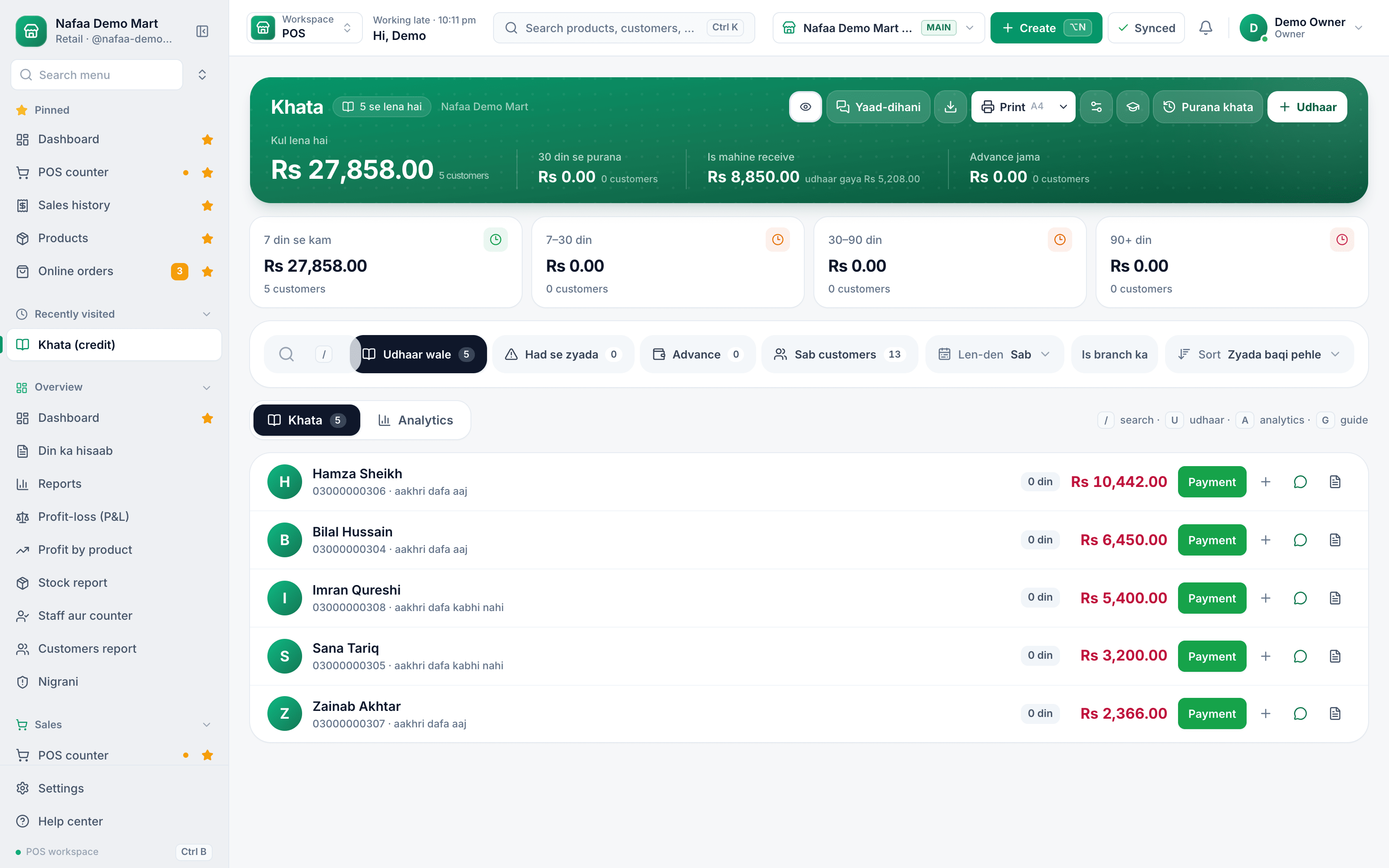
- Total to collect
- Balances by age
- Payment or reminder
A day in each
Picture a kiryana store in Faisalabad with one counter and around 150 bills a day. With a ledger app, the cashier rings up the sale on a calculator or a separate machine, and when a regular customer says "khate mein likh do", someone opens the app and adds the amount by hand. Stock is counted separately. At night the owner adds up the galla and compares it with memory.
With Nafaa, the same cashier scans the items, picks udhaar as the payment, and the customer's balance, the stock and the day's sale all change at once. At closing, the drawer count is checked against what the bills say, and the owner sees the day's sale, Profit and udhaar on the phone.
For a tailor, a contractor or a supplier with a handful of large entries a day, the first way is perfectly fine and costs nothing. For a busy counter, the second saves hours and catches mistakes.
Moving from DigiKhata to Nafaa
If you have a large customer list, our data migration service can enter it for you.
Step 1: Download your balances
DigiKhata lets you download ledgers as PDF reports. Keep a copy of each customer and supplier balance.
Step 2: Add customers with opening balances
Enter each customer in Nafaa with the balance they owe today, so the khata starts where the old one ended.
Step 3: Import your products
Upload an Excel list of products with cost, price and stock; each line is checked before it is saved.
Step 4: Bill for a week
Run the counter on Nafaa and keep DigiKhata open for looking up old entries.
Step 5: Send the first reminders
Use the khata's age buckets to remind the oldest balances first.
Questions to ask before you decide
- How many bills do you make on a busy day, and does a queue form?
- Do you sell from stock that must be counted, or mostly services and large orders?
- Who gives udhaar: only you, or your staff too?
- Do you need to take card payments on the phone, or just record them?
- Which language does your staff read most easily?
If the answers point to a ledger, start with DigiKhata; it is free and widely used. If they point to a counter, start a Nafaa trial and bill a real day. For a wider view of khata apps, see Khata apps compared.
More comparisons
- Compare
Nafaa vs Tally
Nafaa is counter-first software for Pakistani businesses: POS billing, stock, khata and reports. TallyPrime is business management software built around accounting, inventory and tax filing. This page compares them fairly, says when Tally is the better choice, and shows how the two can work together.
- Compare
Nafaa vs Excel
Many shops start with a spreadsheet, and Excel is a very good one. This page compares running a shop in Excel with running it in Nafaa: billing at the counter, stock that updates on each sale, udhaar, several staff and backups. It says honestly when a spreadsheet is enough, and shows how to bring your Excel lists into Nafaa.
- Compare
Nafaa vs Loyverse
Loyverse is a free POS used worldwide, with paid add-ons for longer sales history, employee management and advanced inventory. Nafaa is a paid POS built for Pakistan, with khata, JazzCash and Easypaisa, rupee pricing and purchasing in the product. This page compares them for a Pakistani shop and says plainly when Loyverse is the better choice.
- Compare
Nafaa vs Oscar POS
Oscar is a Pakistani POS for restaurants, retail, grocery, salons, pharmacies and more, with its own card device, a wallet, online ordering and accounting. Nafaa is a POS for the same kinds of business, with udhaar and offline billing at its core. This page compares the two from their own pages and says where Oscar fits better.
- Compare
Nafaa vs CORN POS
CORN POS is a restaurant POS from Pakistan with kitchen displays, tableside ordering, a rider app, branded online ordering and franchise tools, priced per branch in dollars. Nafaa is one system for shops and restaurants alike, priced in rupees. This page compares them for a restaurant or cafe and says where CORN POS is the stronger fit.
- Compare
Nafaa vs Odoo
Odoo is an open source suite of business apps, from accounting and inventory to manufacturing, HR and websites, with a Point of Sale app among them. Nafaa is a POS-first system for Pakistani shops and restaurants. This page compares them for a business in Pakistan and is clear about when Odoo is the better fit.